Prompt Cutter
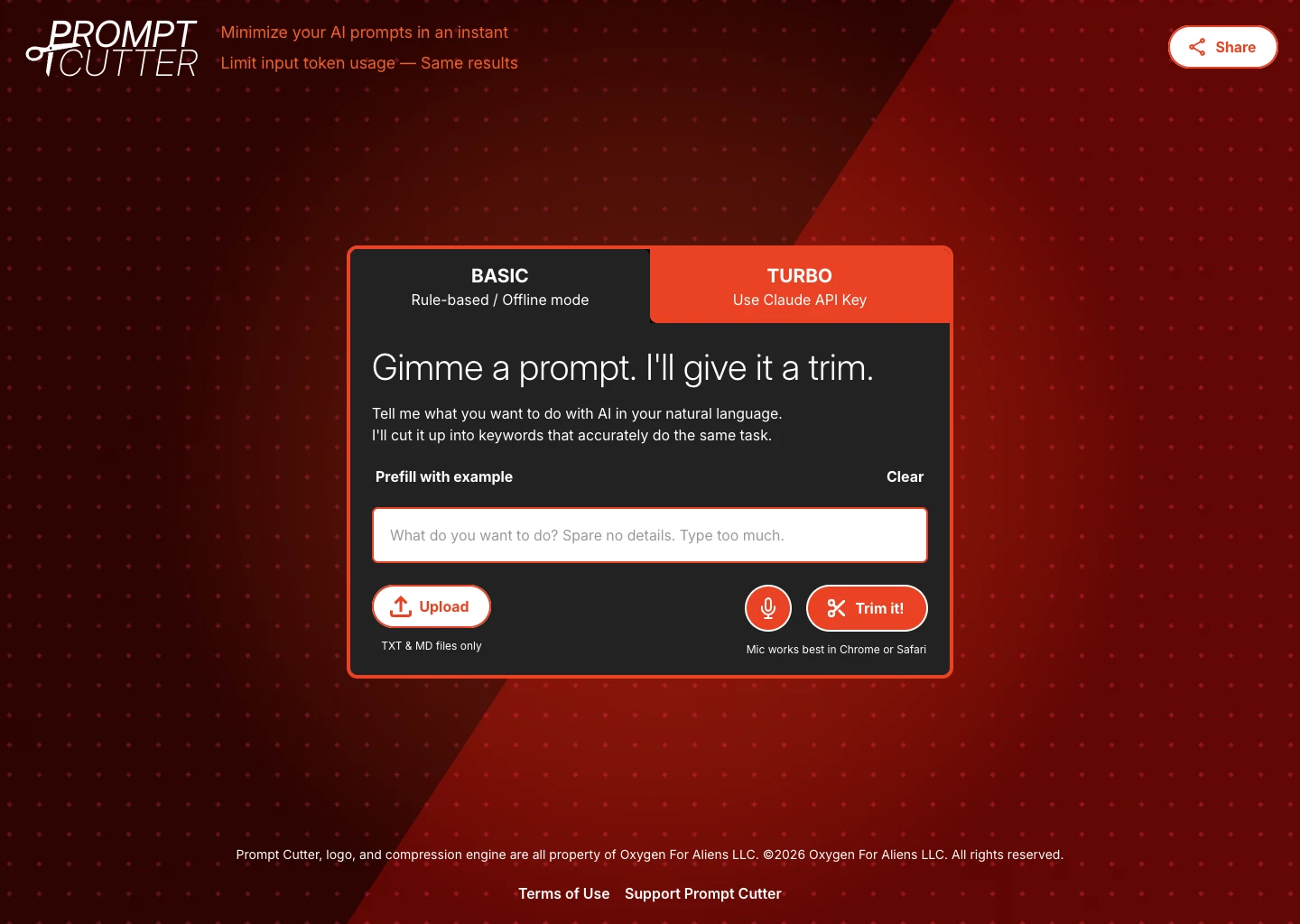
A browser‑based AI prompt compression tool, built as a single portable file with a BYOK approach to LLM‑assisted compression.
My Role
End‑to‑end: design‑to‑code, architecture, front‑end, build tooling, security hardening
Scale
Single self‑contained file, ~1,467 lines, four responsive breakpoints (393px–1462px)
Traction
2,000+ visits in its first five weeks; 1 in 30 sessions runs 5+ minutes
Stack
Vanilla HTML/CSS/JS · Claude (Anthropic API) · Cloudflare Workers
Designing and shipping an AI product end to end, including the business model.
Ownership
I owned everything: product design, architecture, front end, build tooling, and security hardening. It ships as a single self‑contained file of about 1,467 lines across four responsive breakpoints.
Judgment calls
- Subtraction Subtraction is the product. Prompt Cutter removes what a model doesn’t need from a prompt, and the build follows the same rule: one portable file, no framework, no account, and no server in the middle.
- Bring your own key. Turbo mode uses the user’s own Anthropic key, so usage and cost never pass through Prompt Cutter. That one decision settles the cost model and the trust question.
- A free tier that’s actually free. Basic mode compresses offline in the browser with no account, so the value is clear before anyone pays for anything.
- Show the diff. To the user, an AI rewriting their prompt is a trust problem before it’s a savings feature. People won’t paste a rewritten prompt they can’t check, so the diff view shows exactly what was cut.
Quality bar
Security hardening was part of the scope, not an afterthought. In internal benchmarks of 59 real‑world prompts across seven categories, the free offline engine cut input tokens by an average of 20%, ranging from 10% on data‑extraction prompts to 35% on conversational chat, while 98% of trimmed prompts kept their meaning, as rated by an AI judge.
- 20% fewer input tokens on average
- 10–35% depending on the kind of prompt
- 98% of trimmed prompts kept their meaning
Why it matters for a team
I can sit with engineers on LLM cost, latency, and trust trade‑offs because I’ve had to make them myself.