RyderGyde
Get Roadside Assistance fast, right when you need it — plus locations, fuel rates, and maintenance.
A stranded driver doesn’t have time to figure out an app.
Rethinking how stranded drivers get help, from 1% digital adoption to a flow every tester completed.
Scope
Design lead on Ryder’s driver app. Before the redesign, only 1% of Roadside Assistance cases started in RyderGyde. I led a team of 2 designers and a front‑end developer, working with dozens of subject matter experts, the CMO, the Head of Product Development, and an engineering team over 2 years. It was a large‑budget mobile product, and beyond Roadside Assistance I designed many other parts of the app.
The calls I made
Research showed the problem wasn’t the screens. Drivers don’t want another app, didn’t know this one existed, and trust a phone call in an emergency. Evidence With only 1% of cases starting in the app, the numbers showed this wasn’t a marketing problem. The product asked drivers to change their behavior at the worst possible moment, so the product had to meet them where they already were.
Subtraction Rather than polishing the existing flow, I made three strategic calls, each of which removes something: no app download, no registration, and no hunting for an entry point.
- Web over native. A web app needs no download, which removes the biggest barrier to adoption.
- Register vehicles, not drivers. Profiles are tied to the truck, so the driver only needs their name at check‑in.
- A QR code sticker on every windshield that opens a pre‑filled request, putting the entry point where the emergency happens.
How I led
- Ran in‑person usability studies with 12 truck drivers at a working Ryder facility, testing in the real context instead of a lab. You can’t understand a stranded driver’s perspective from a conference room.
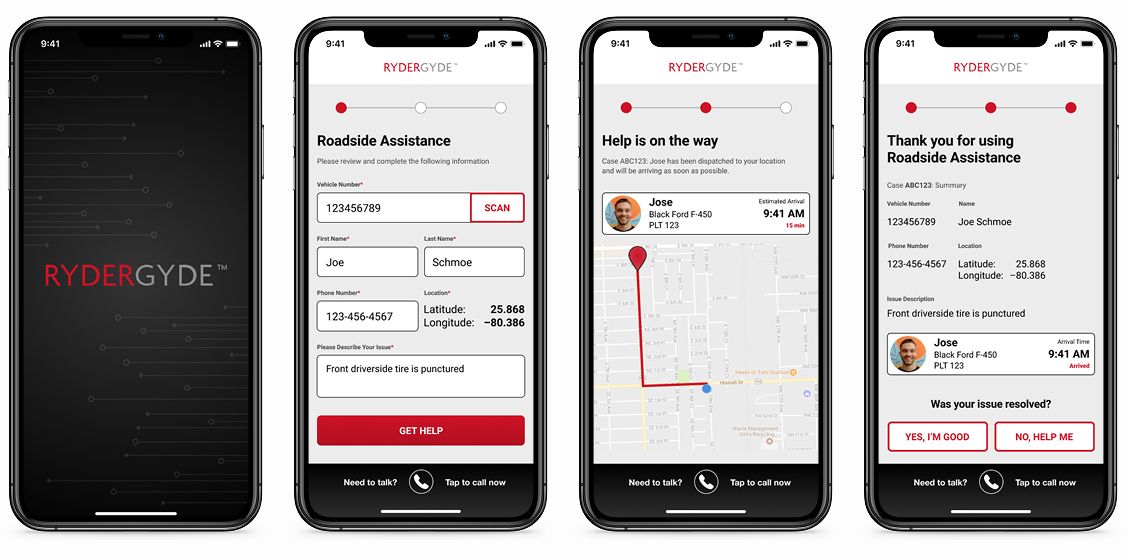
- Cut the request flow to 3 steps with real‑time GPS tracking of the assistance vehicle. A stranded driver shouldn’t have to make a single decision that isn’t necessary. Simplicity The vehicle lookup, dispatch, and tracking all happen behind the scenes. The driver scans a sticker and types their name.
Influence
- Found the next problem without being asked. Fuel receipts were still reconciled by hand on paper, so I designed a mobile flow that captures receipts on the road and organizes them for IFTA fuel tax reporting, freeing up accounting time.
- Delivered the working prototype for presentations and engineering handoff.
Outcome
- 100% of drivers received assistance in testing
- 92% said they’d use it again
- 12 drivers tested at a working Ryder facility
- No retest needed: first‑round results were strong enough to move straight to high‑fidelity mockups.
- Shipped as part of Ryder Roadside Assistance (opens in new tab).
- Lasting impact: after a light redesign following my exit, the core idea, structure, and process remain, and QR codes are now in every truck.
- I left right after launch, before post‑release adoption numbers were available.
Final Prototype
The final step before handing off our designs to the development team was to take our high-fidelity mockups and create a working prototype. It anchored stakeholder presentations, helped us verify final details with testers, and gave developers a visual reference to build from.