Profit Prophet
Find the right price in seconds — one that balances profit and value.
Product, client, and persona names have been changed for confidentiality.
There’s a best price for every product. Most teams never find it.
Cutting a 30+ dashboard platform down to what each role actually needs.
Scope
Design lead on a pricing optimization platform whose 30+ dashboards were built from insights gathered over hundreds of prior client engagements. I led a design team of 3 mid‑level designers, working with a product lead, 2 project managers, a full engineering team, and dozens of pricing subject matter experts over 2 years.
The call I made
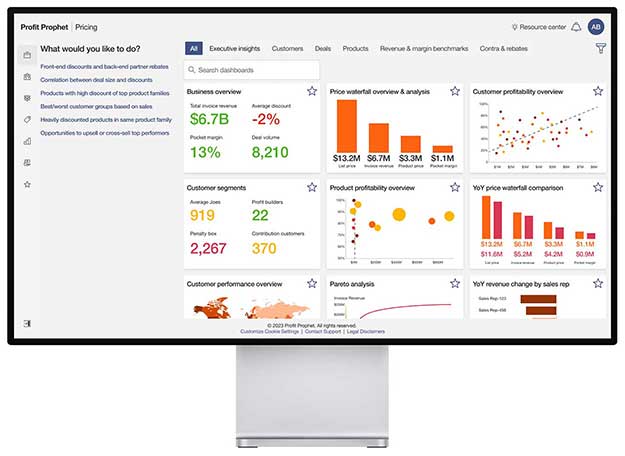
The dashboards tested well: 87.5% of participants preferred them to their current tool. But 75% found the homepage overwhelming (“I don’t know where to start”). The problem wasn’t any one dashboard; it was the sheer number of them.
Subtraction I design by subtraction, so the answer wasn’t a better way to browse 30 dashboards; it was showing fewer. I pushed to curate dashboards by role and lead with a Quick Start menu of common tasks, which meant removing options the platform had accumulated over years.
- 8 moderated sessions, about 1 hour each
- 100% completed the price adjustment task
- 75% found the original homepage overwhelming
How I led
- Directed the research behind two personas on opposite sides of the same negotiation, a Pricing Lead and a Sales Team Lead, so the design served the handoff between them and not just one user.
- Evidence The 30+ dashboards reflected years of client and stakeholder requests. The test data said something different, so I took that finding to stakeholders and subject matter experts, and the prioritization was decided together on that basis.
- Benchmarked against Zilliant, Vendavo, and Pricefx and turned their gaps into four opportunities, with an interactive Price Waterfall at the center.
- Grew the team. All three designers grew significantly over the project, especially at stripping out clutter and extra information, and every dashboard was streamlined as a result. Subtraction became the team’s habit, not just mine.
Influence
- Worked with stakeholders and subject matter experts to agree which dashboards and actions mattered for each role. Removing features from an established product means making and winning that argument, not just making the design.
- Brought the team’s designs together into the working prototype used for stakeholder presentations, validation, and engineering handoff.
Outcome
- Retest: all participants completed tasks more efficiently and praised the changes.
- Shipped as a pricing and promotion platform with machine learning, what‑if scenarios, and industry benchmarks.
- Lasting impact: the dashboards my team and I designed remain in the product, largely unchanged since we created them.
- I rolled off the project at launch, before post‑release metrics were available.
Final Prototype
The final step before handing off our designs to the development team was to take our high-fidelity mockups and create a working prototype. It anchored stakeholder presentations, helped us verify final details with testers, and gave developers a visual reference to build from.