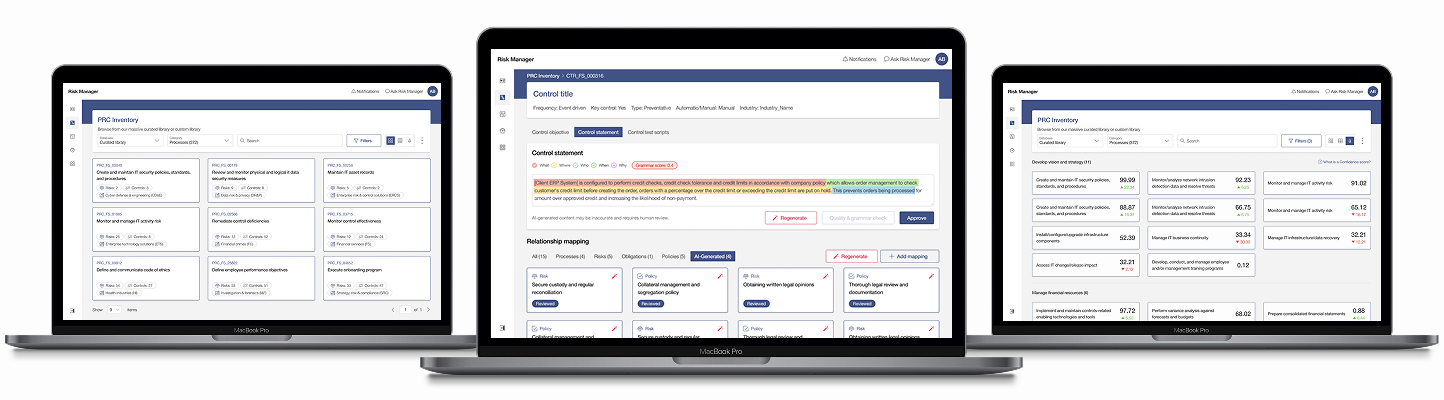
Risk Manager
Resolve compliance issues fast with AI-powered guidance through Process Risk and Controls.
Product, client, and persona names have been changed for confidentiality.
Risk hides in the details most teams don’t have time to check
Turning a compliance platform with more than a hundred thousand records into something an analyst can trust at a glance.
Scope
Design lead on an AI‑powered Process Risk and Controls platform for regulated industries like finance and healthcare. I led a design team of 3 mid‑level designers, working with a product lead, a UX manager, 2 project managers, engineering, and dozens of PRC subject matter experts over 1 year and 3 months.
The call I made
Testing showed that every participant read a high risk score as good news (“Oh, that’s bad?!”). Evidence The scoring was correct by the data’s own logic, but 10 out of 10 testers read it backwards, and a measured result like that outweighs internal logic.
The finding met real resistance. The whole feature was built around the risk score, and so was the tool PRC consultants already used, down to the equation that calculated it. When the leadership team heard the feedback, changing the score felt like changing the product’s foundation. Over several meetings with the team, I worked toward a fix that didn’t require one: invert the score. The equation is the same, it’s just scored in reverse and renamed the Confidence Score, so higher now means better. That met every criterion, kept the calculation the consultants depended on, and turned resistance into agreement.
Subtraction No new model and no new math, just the smallest change that fixed the problem. Simplicity Behind each score sit regulations, processes, risks, and controls from a repository of more than a hundred thousand records. The analyst sees one number where higher is better.
- 10 moderated sessions, about 1 hour each
- 100% confused by the original risk scoring
- 100% completed the core task, so the flow itself held up
How I led
- Led and delegated the research end to end: competitive analysis, expert interviews, empathy mapping, and two personas covering both sides of the approval workflow.
- Facilitated the team’s affinity mapping, which turned competitor gaps into four product opportunities, including using generative AI to trace regulatory changes to the controls they affect.
- Ran moderated sessions with stakeholders and PRC experts, then a retest to confirm the fixes held.
Influence
- Subtraction 70% of testers said the cards showed too much. I brought the PRC experts into the cutting decisions instead of working around them. Together we reduced cards and tables to essentials, removed the tab component, and simplified search to filter by category. Even experts move faster with less on screen.
- Delivered a working prototype that served three audiences at once: stakeholder presentations, final validation with testers, and the visual reference for engineering. Because everyone could see how users would interact with the product, production and decisions moved much faster.
Outcome
- Retest: all participants completed their tasks more efficiently.
- Shipped as an AI‑powered risk and compliance product that maps regulations to processes, risks, and controls, helps draft procedures, policies, and tests, and connects to clients’ existing GRC and ERP systems.
- Lasting impact: the simplified, rearranged components became part of the product’s design system and are used throughout it, and Confidence Scores are still in the product today.
- I rolled off the project at launch, before post‑release metrics were available.
Final Prototype
The final step before handing off our designs to the development team was to take our high-fidelity mockups and create a working prototype. It anchored stakeholder presentations, helped us verify final details with testers, and gave developers a visual reference to build from.